
When a system loses two-thirds of its workload in six years, nobody in IT calls it a trend. They call it a migration, and they go find out where the load went.
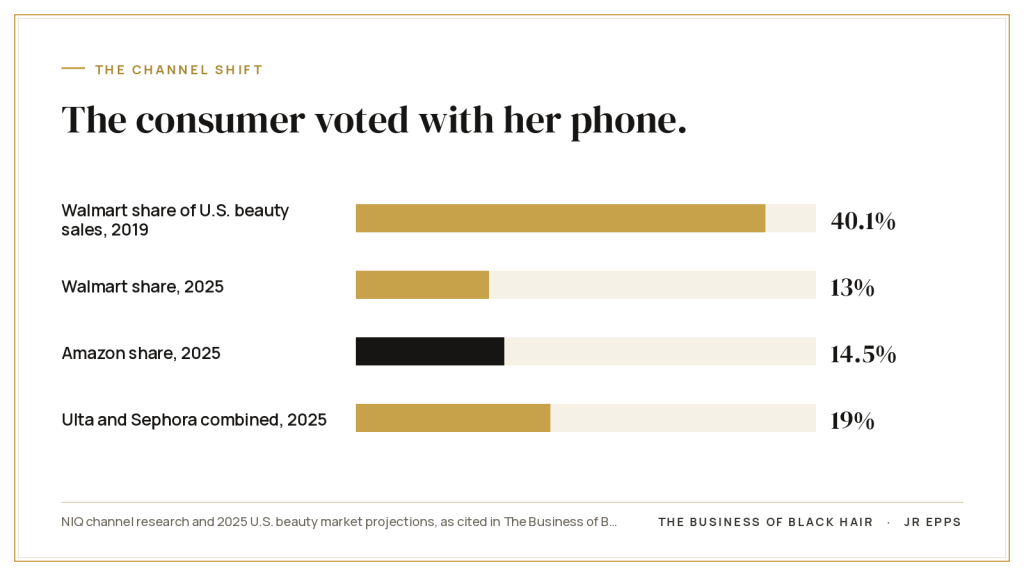
In 2019 Walmart held 40.1% of U.S. beauty sales. By 2025 it held 13%. Amazon, at about 14.5% and roughly $26 billion, passed it for the first time. For Black beauty consumers specifically, NIQ found Amazon is now the number one outlet across every income level. Walmart second, Target third. The fastest-growing channel in the whole category is TikTok Shop, where health and beauty is nearly 80% of U.S. sales and independent brands are growing at 16.1% against 7.4% for the conglomerates.
Read that last pair of numbers again, because it is the thesis of this whole series in one line. The discovery-based model, watch a woman with your hair type use a product and then buy it, was invented in forums like Black Hair Media around 2002. Women did it for free, for each other, with no checkout button. TikTok Shop added the checkout button. Independent Black-founded brands are finally getting paid for the model they built.
What it means for the physical shelf: about 60% of the $1.3 billion textured hair market is still bought in stores, and that share drops monthly. The routine purchases, the deep conditioner every six weeks, the edge control every month, migrate online first, because the customer has time to compare. The emergency purchase before a Monday meeting stays local. That is a much smaller business than the one the stores were built on.
Root cause: the shelf’s advantage was never curation, price or service. It was proximity. The internet made proximity irrelevant, and the retailers who had leaned on it had nothing underneath.
The Business of Black Hair coins a term for this, eCommerce Location Neutrality. It gets its own post.