
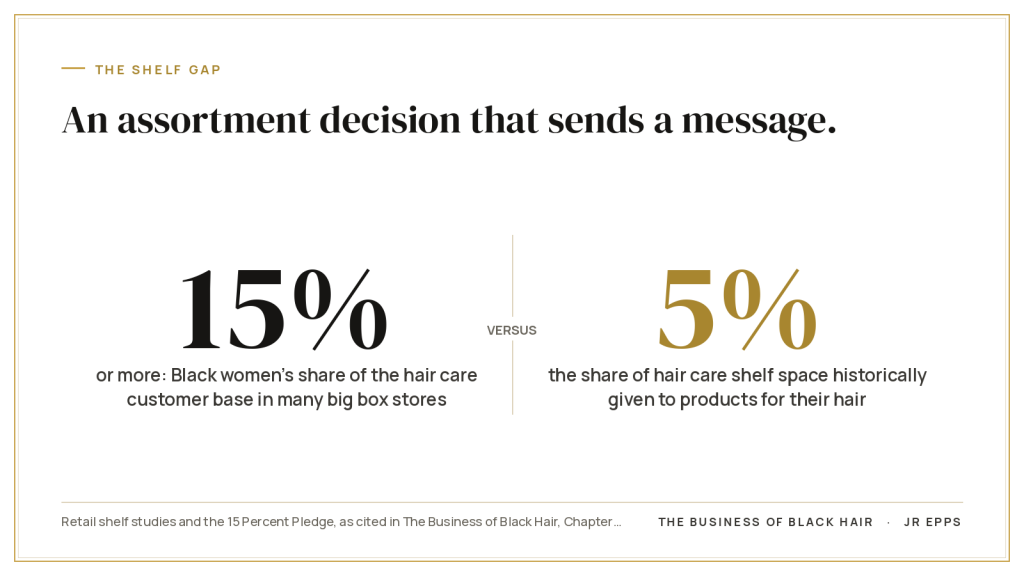
Walk into a Walmart. Find the hair care aisle. Count the products. Now count the ones formulated for Black hair. Then look up what share of that store’s customers are Black. The math has never matched, and for decades the mismatch was not an error. It was a decision.
Black shoppers are roughly 14% of Target’s in-store customers, a number both Target and Walmart have cited proudly in shareholder material. In the same stores, products for Black hair have historically occupied as little as 5% of hair care shelf space, often in a cramped “ethnic” section at the end of the aisle, and until June 2020 frequently behind a locked case. You could lift a $400 air fryer off an open shelf and wait for an employee to unlock a $6.99 edge control. Essie Grundy sued Walmart over that in 2018. The settlement came in 2019. The cases came off in 2020, the week after George Floyd was killed. That two-year gap is the story.
The industry term for the shelf split is an assortment decision, made on sales velocity. Stock fewer products for Black hair, sell fewer products for Black hair, and then cite the sales as proof the category does not deserve more space. Business lesson 101: open a restaurant with three items on the menu, conclude your customers only want three items, and your board questions your judgment. The hair aisle ran that experiment for twenty years and called it category performance data.
Root cause: constrained choice was mistaken for preference. The customer was not choosing. She was navigating scarcity.
Walmart began integrating the aisle by hair type in 2024, which helps, as long as independent brands can afford the placement next to P&G. Either way, The Business of Black Hair shows the shelf has already lost the only advantage it had. Next post: where the money actually went.