
Twenty years ago I moved into a nice subdivision and started eating at the McDonald’s off the freeway. The service was bad enough that I caught myself writing off the whole area because of it. Then a Chick-fil-A opened in the same parking lot, hiring from the same labor pool, in some cases the same kids, and the experience was completely different. Same neighborhood. Different management. The diagnosis was never the zip code.
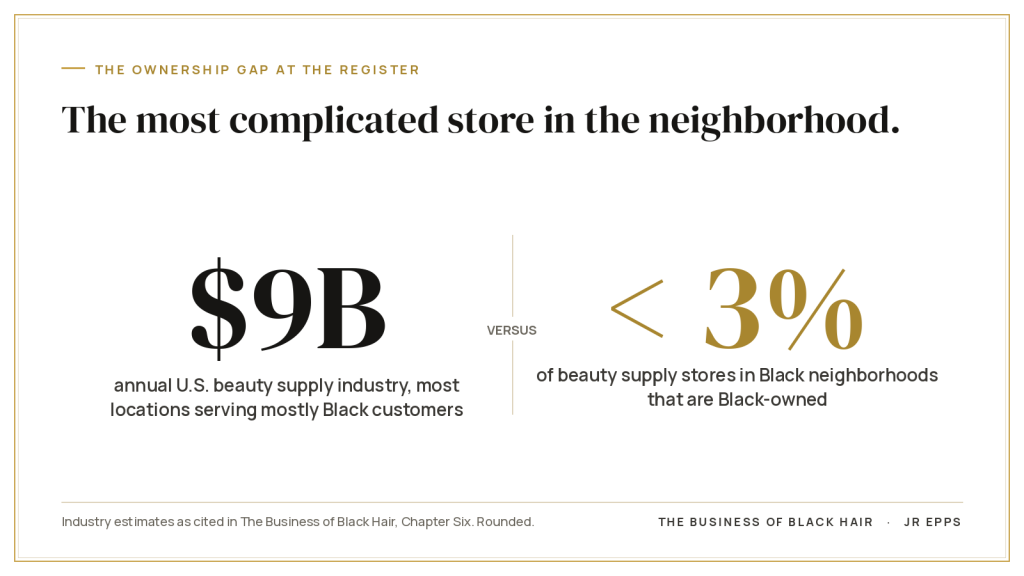
Keep that in mind walking into a beauty supply store. The U.S. beauty supply industry does about $9 billion a year, with most stores serving mostly Black customers. Less than 3% of the stores in Black neighborhoods are Black-owned. The locked cases, the employee who follows you down the aisle, the no-returns policy, the body language that says you are being monitored rather than welcomed. Those are not neighborhood problems. They are management decisions, and they tell the customer exactly how she is valued in the transaction.
The structure above the store matters more than the face behind the counter. Korean American entrepreneurs entered the niche in the 1970s and 80s using a community lending system called a kye at the exact moment banks were leaving Black neighborhoods. They built supplier relationships, and the distributors above them, Jinny Beauty Supply being the largest, became the invisible layer that decides what reaches the shelf. Getting in requires minimums, proof of velocity and relationships that exist in Korean. It is not a law. It is infrastructure.
Business lesson 101: the most powerful position in any market is not the maker or the buyer. It is whoever controls the space between them.
Root cause: the demographics of ownership are a symptom. The disease is a community with enormous spending power and no capital infrastructure to capture its own market. The Business of Black Hair says what changes it, and it is not a boycott. It is the post after next.