
In data work there is a difference between having access to information and being able to act on it. Every dashboard in the building can be open and a decision still goes wrong if nobody can read what it says. That is data literacy, and the consumer version of it is the fourth lock in The Business of Black Hair: the ownership literacy gap.
Here is the gap. The label says SheaMoisture. It does not say Unilever. The label says Mielle Organics. It does not say Procter & Gamble. Carol’s Daughter spent 2014 to 2025 inside L’Oréal and most customers never knew it left, or that it came back. The founder’s face stays on the website. The origin story stays on the bottle. The corporate parent stays invisible, because the entire industry runs on the fact that people form attachments to brands, not corporations. Nobody has feelings about Unilever.
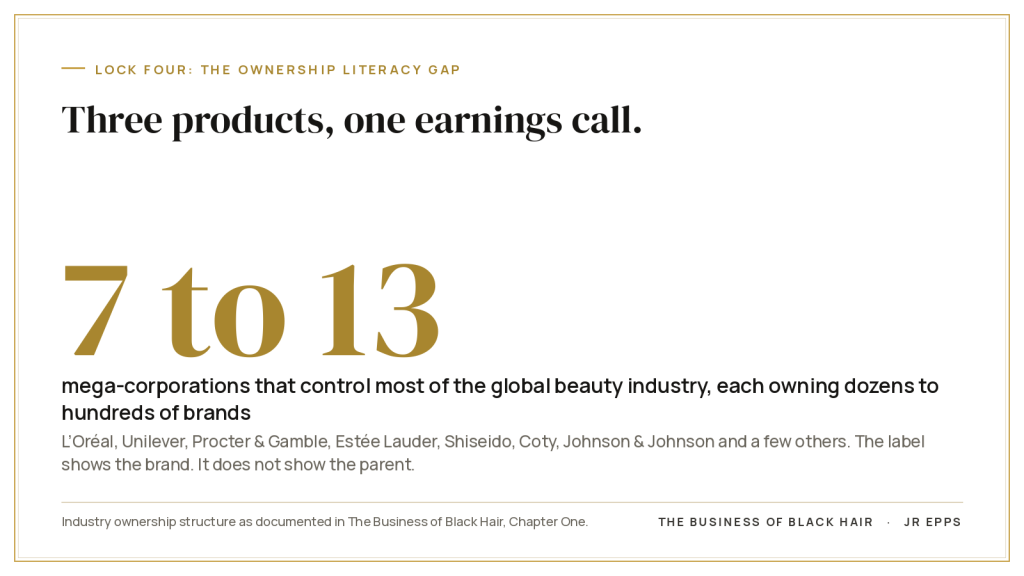
Behind the shelf, the global beauty industry is controlled by roughly seven to thirteen mega-corporations. Between them they own hundreds of brands that look like competitors in the aisle and report to the same quarterly earnings call. A woman choosing between three products may believe she is choosing between three companies. Often she is choosing between three labels owned by one.
That matters because every purchase is a capital allocation decision. Every swipe in the beauty aisle is a vote for a supply chain and an ownership structure. Right now most of those votes are cast without a ballot that says who is running.
Root cause: not ignorance and not apathy. A literacy gap, maintained on purpose, by an industry that profits from the gap staying exactly as wide as it is.
The fix is unglamorous: look up the parent company before the next repurchase. It takes thirty seconds. The book includes the Black-founded brands that are still independently owned, with their websites, so the ballot has names on it.