
Most of what I document in this series runs one direction: value created by Black women, captured by someone else. This number runs the other way, and that is why it matters.
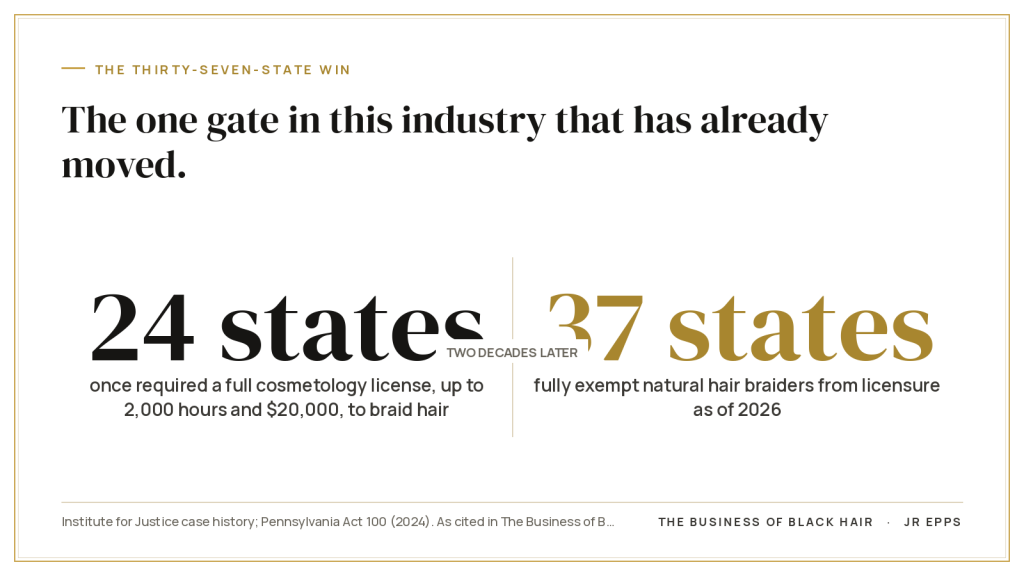
At the peak of the regime, 24 states required anyone braiding hair professionally to hold a full cosmetology license. Up to 2,000 hours. Tuition north of $20,000. For a craft that uses no chemicals and no cutting tools, taught in programs that, by their own curriculum, did not include braiding. Pamela Ferrell, co-owner of Cornrows & Co. in Washington, D.C., described it plainly: pay $20,000 to learn things you will never do, for permission to do something you have done since childhood. She sued, and won a specialty license. That was one city. It took a lawsuit.
Then the pattern repeated, state by state, for about twenty years. New Jersey went from a 1,200-hour program costing $17,000 to a 40-to-50-hour specialty license. Pennsylvania, which had required 300 hours and a board exam since 2006, eliminated the requirement entirely with Act 100 in late 2024. As of 2026, 37 states fully exempt natural hair braiders from licensure.
Be honest about the scope. Braiding deregulation did not change who owns the supply chain, who controls distribution or who captures the margin on a $16.2 billion market. It removed one barrier at one entry point. But it proved something the rest of the structure rarely allows you to see: when the people most affected by a system organize around the specific mechanics of what is wrong with it, litigation, legislation and public-interest research, the system moves.
Root cause of the win: the braiders did not argue that the system was unfair. They documented exactly how it worked and who it paid. That is also the method of The Business of Black Hair. Receipts, then leverage.