
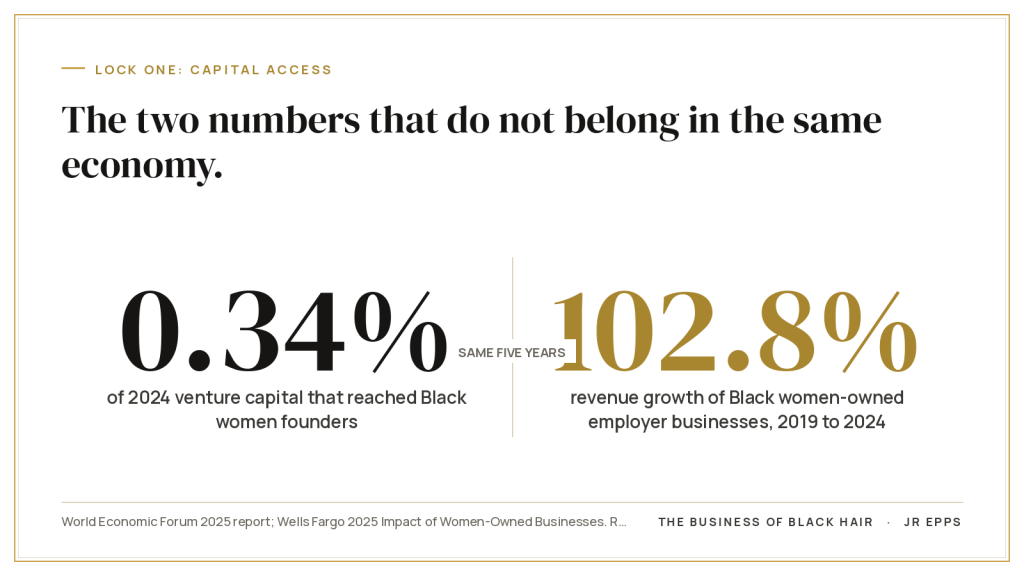
When two metrics on the same dashboard point in opposite directions, an engineer does not pick the one that feels right. You go find out which system is broken.
Here are the two metrics. In 2024, Black women founders received 0.34% of venture capital. In a year when the global VC market deployed $289 billion, that share rounds to zero. Over the same stretch, 2019 to 2024, Black women-owned employer businesses grew revenue by 102.8%. More than doubled. Headcount grew 44% in the same period. Even the one-person operations, no employees at all, generated $44.6 billion in combined revenue.
So which system is broken? Not the founders. A group that doubles revenue with no institutional money has the operational skill, the market intelligence and the demand signal to build at scale. They are doing it on savings, personal debt and reorders. The broken system is the one that claims to allocate capital to its best use and keeps missing the fastest-growing segment in the country.
The Business of Black Hair names this Lock One of four: capital access. It matters most in hair care because the founder who understands the product best, because she uses it, is the founder least likely to be funded to build it. The lemonade man who never drinks lemonade gets the check. The woman with the 4C line in Houston does not.
Root cause: the capital market prices the founder, not the business. The business numbers say the opposite of what the funding numbers say.
The practical reading is in Chapter Twelve. If the capital is not coming, the startup cost has to come down instead. It did, by about 90%, and the next few posts will show the bill.