
Price discrimination sounds like an accusation. In pricing strategy it is a method, and it is measurable. You put two comparable products on the same shelf, made by the same parent company, and compare the price per ounce.
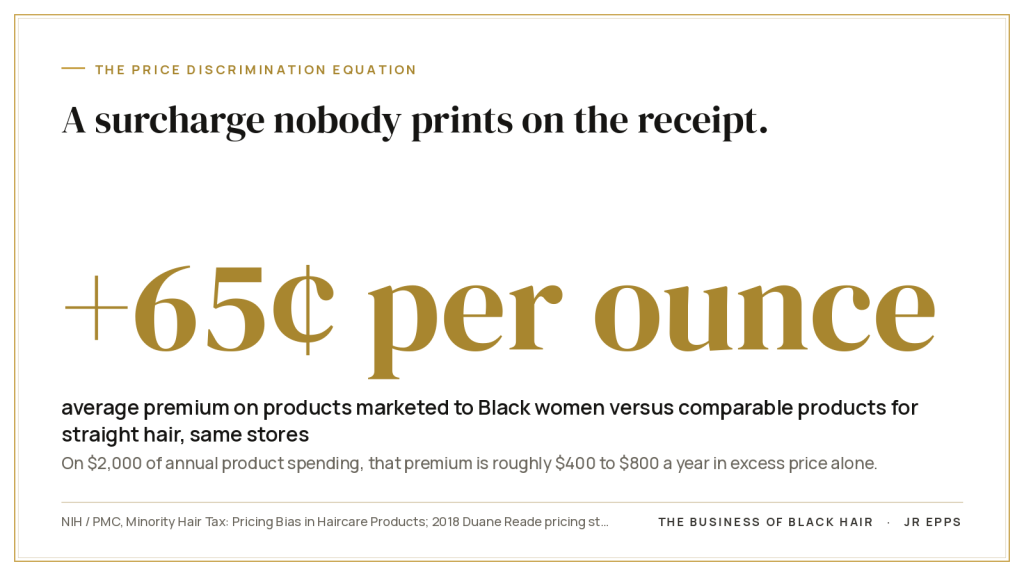
Researchers have done exactly that, in Duane Reade, CVS, Walgreens, Target and Walmart. Products marketed to Black women cost about 65 cents more per ounce than comparable products for straight hair. The industry explanation is “specialized formulation costs.” The market explanation is simpler: a captive customer with fewer alternatives can be charged more, and will absorb it.
Sixty-five cents does not sound like much until you run it across a year. On $2,000 of product spending, the premium alone comes to roughly $400 to $800. Then 2025 added a multiplier. Synthetic braiding hair, extensions, wigs, tools and packaging for independent brands are overwhelmingly made in China, and tariffs of up to 145% landed on that exact supply chain. A woman who braids her own hair four times a year to save money absorbed the increase in cash, with no domestic supplier to switch to.
The Business of Black Hair calls this the Afro Tax, and it is careful about what it is not. It is not a conspiracy. It is what any pricing course would call rational behavior in a low-competition segment. The textbook would not call it racism. The textbook would call it exploiting inelastic demand, and the textbook would be right. That is the problem.
Root cause: the person setting the price has never paid it. When that is true, the price will always be wrong.
Next post: what the 65 cents adds up to when you count the whole bill, including the hours.