
In business, when your product creates a cost that lands on someone else’s balance sheet, it is called an externality. Here is one nobody has written the textbook for.
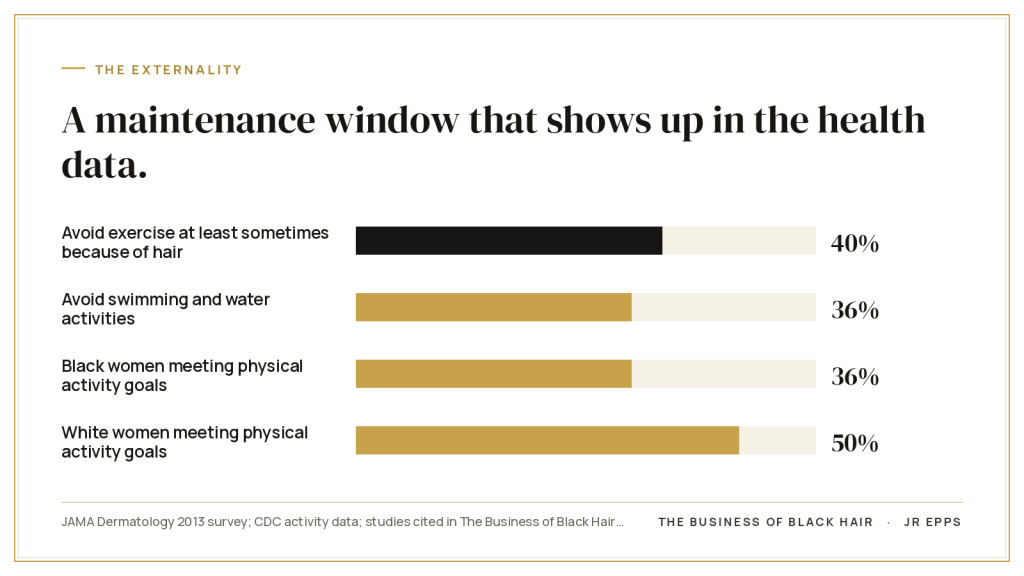
A 2013 study in JAMA Dermatology surveyed Black women and found that nearly 40% avoided exercise at least sometimes because of their hair. The reasons were not vanity. They were logistics: sweating out a style that took hours, and the time it takes to wash, dry and restyle afterward. A separate study found about 36% avoid swimming for the same reason. Across the research the range runs 38 to 48 percent.
Scale it. There are roughly 21 million Black women in the United States. If 38% change their physical activity around hair maintenance, that is about 8 million people making health decisions around a cost the industry never counts. Downstream, the numbers are documented: 36% of Black women meet physical activity guidelines versus 50% of white women, with higher rates of hypertension, cardiovascular disease and type 2 diabetes. Those gaps have many causes. Peer-reviewed research lists hair care as one measurable contributor to the activity gap.
A former U.S. Surgeon General, Dr. Regina Benjamin, flagged this in 2011 as a public health concern, not a beauty one. More than a decade later the four-to-eight-hour maintenance window is still the standard, and the marketing still celebrates wash day as self-care without once mentioning the arithmetic.
Root cause: the product was formulated around a maintenance cadence, and the cost of that cadence was pushed onto the customer and, eventually, onto the health care system. Neither cost appears on the manufacturer’s P&L.
The Business of Black Hair is not a wellness book. But if you have ever skipped the gym on a Thursday because wash day is Sunday, the number has a name now.