
Here is something that has never appeared in a Bureau of Labor Statistics report: the economic value of wash day.
Every Sunday, or whichever day gets planned around it, Black women across the country perform skilled, multi-hour labor on their own hair. Pre-poo, detangle under water, shampoo, deep condition with heat, section, apply leave-in and styling product, dry. Four to eight hours for 4C hair. The knowledge behind it, porosity, density, shrinkage, moisture-protein balance, which products layer and which ones build up, would be called expertise in any other field and paid accordingly. A cosmetologist charges $75 to $200 for one wash-and-style session.
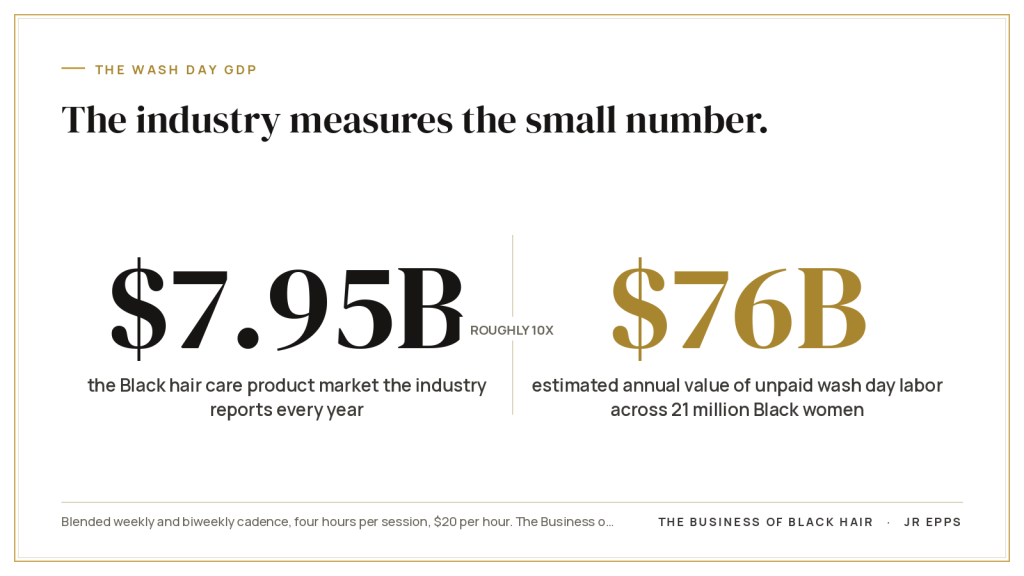
So count it. Twenty-one million Black women. Four hours a session, somewhere between weekly and every other week. Twenty dollars an hour, a conservative replacement rate. Blended across cadence that comes to about $76 billion a year. Weekly alone would be $87 billion. Biweekly alone, $43 billion. None of those numbers include protective style installs, which add four to twelve hours every month or two.
Now put it next to the number the industry does report: $7.95 billion in product sales. The labor market is roughly ten times the product market. The industry measures the small one. It profits from the big one by not measuring it.
That is not a complaint. It is accounting. When your product only works after the customer supplies several hours of skilled labor, that labor is part of your cost structure. It just lives on her side of the ledger.
Root cause: labor performed at home, for your own care, is excluded from every framework we use to measure the economy. The hair care industry built its margins inside that blind spot.
The Business of Black Hair spends a chapter on the wash day economy, including the part the health data has to say about it. That is the next post.