
In 2006 a woman named CharyJay uploaded a video of herself detangling 4C hair. No ring light, no media kit, no sponsor. Just the process thousands of women on forums like Black Hair Media had been describing in text, now visible. Tens of thousands watched, because nobody else, not the brands, not the magazines, not the cosmetology schools, was showing them how to care for their own hair. The natural hair YouTube economy grew from there. Then the industry grew on top of it.
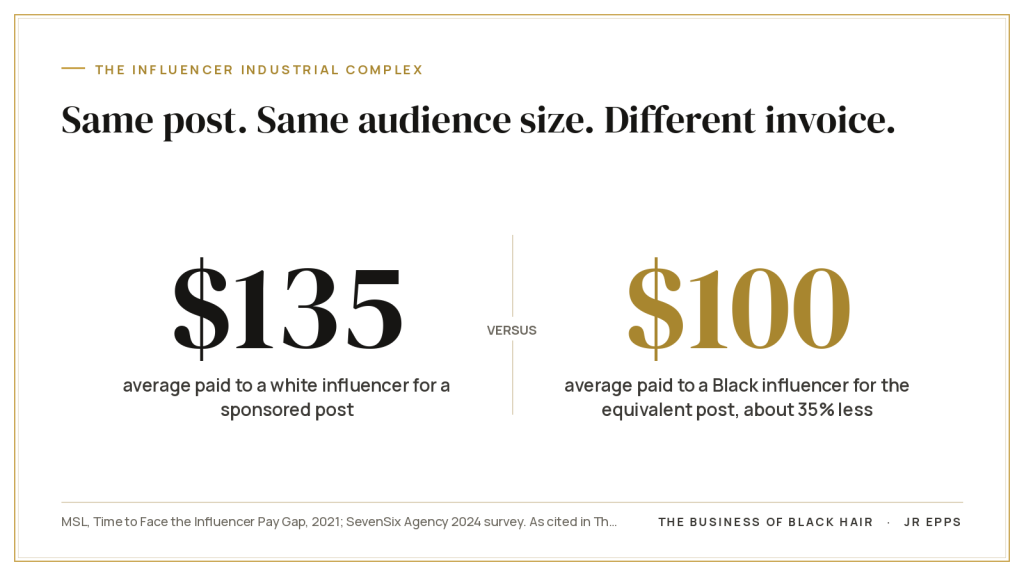
Influencer marketing was a $1.7 billion business in 2016 and $24 billion by 2024. Beauty is its largest vertical. And inside it, the people who built the foundation are paid least. A 2021 MSL study found Black influencers earn 35% less than white influencers for equivalent work: $100 against $135 for the same sponsored post. For comparison, the Black-white pay gap in business and finance is 16%. By 2024 the SevenSix Agency measured the influencer gap at 34%, up from 22% two years earlier. Stanford research documented the mechanism: creators of color are asked to work for free more often, offered money less often, and lose negotiations more often. Seventy-three percent of white influencers land a paid deal within a year. For Black creators, 46%.
The metrics doing the pricing are not neutral. Agencies weight raw follower count over purchase intent, so a Black hair creator with 200,000 followers who buy what she recommends is priced below a generalist with 500,000 who scroll past. In this category she is not a marketing channel. She is the credentialing system that decides which brands the community trusts.
Business lesson 101: if your top-performing sales channel is the one you pay 35% below market, a competent CFO calls that a retention risk. Brands call it standard practice, until she launches her own line and takes the audience with her.
Root cause: the person who needs the brand deal more than the brand needs her negotiates from the weaker position, and the brand knows it.
The Business of Black Hair argues the brand deal was never the destination. It was proof of concept. The destination is ownership.