
Imani Jackson was hired for a sales job in Shreveport in 2018 wearing a long straight wig, which the owner called beautiful hair. Gluing it on took forty-five minutes every morning in Louisiana humidity. When she stopped and came in with her own 4A hair in a neat bun, HR was told to counsel her about looking professional. Two months in, she was fired. The EEOC sued. The company settled for $50,000. That is the price the system assigned to showing up as yourself.
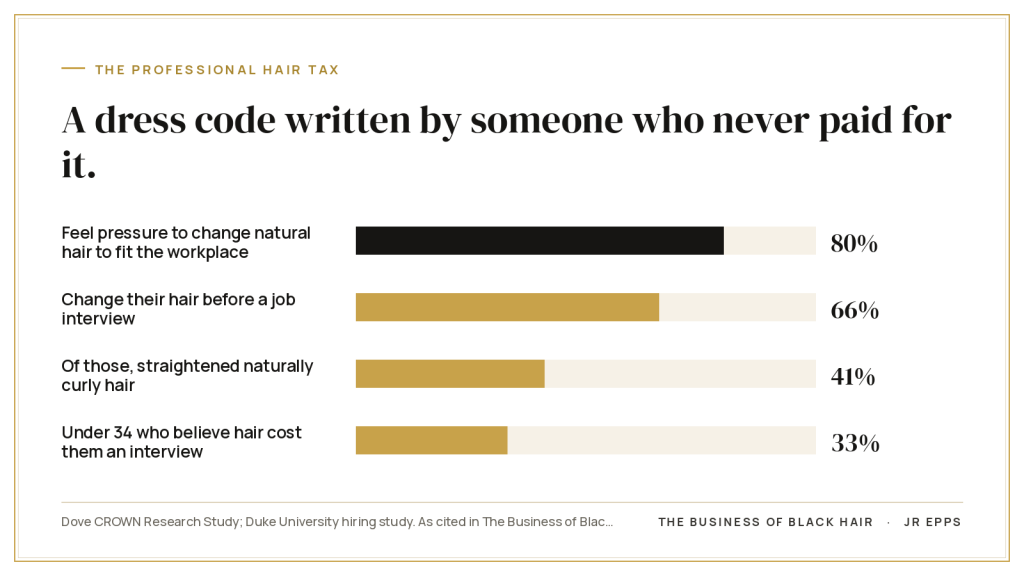
She is a data point in a documented pattern. The CROWN Research Study found 80% of Black women feel pressure to change their natural hair to fit the workplace. Two-thirds change their hair before a job interview; of those, 41% straighten it. One in three under 34 believe they have been denied an interview because of their hair. Black women are one and a half times more likely to be sent home from work over a hairstyle. A Duke study found candidates with curlier hair were rated less professional and less competent from identical resumes.
The legal system has largely looked at this and called it a choice. In 2016 a federal appeals court ruled that rescinding Chastity Jones’s job offer over her locs was legal because hair is a “mutable characteristic.” She could, in theory, cut it. The entire cost of compliance was assigned to the worker. As of 2026, 25 states plus D.C. have passed the CROWN Act, which makes that illegal. In the other 25, it is not.
Here is the compounding structure no diversity report mentions. The Afro Tax charges her more to maintain her hair. The conformity tax, $80 to $200 a straightening visit, $50 to $120 every six to eight weeks for a relaxer, charges her again to neutralize it. Business lesson 101: no HR department would write “we will charge you to do your job, then charge you again to look like you are doing it.” Grooming policies do exactly that. They just use the word professional instead of an invoice.
Root cause: a standard set by people who never paid either bill, applied in rooms that were not designed with her in them. The Business of Black Hair makes the business case for fixing it in the only terms that move a budget: retention, recruiting and litigation risk.