
Here is a result that should not exist, according to the baselines. Across the general population, women adopt generative AI at noticeably lower rates than men, roughly 33% against 44%. Public polling shows deep skepticism about AI accuracy. A demographic that has repeatedly been burned by systems it did not design should, on paper, be the most cautious adopter in the country.
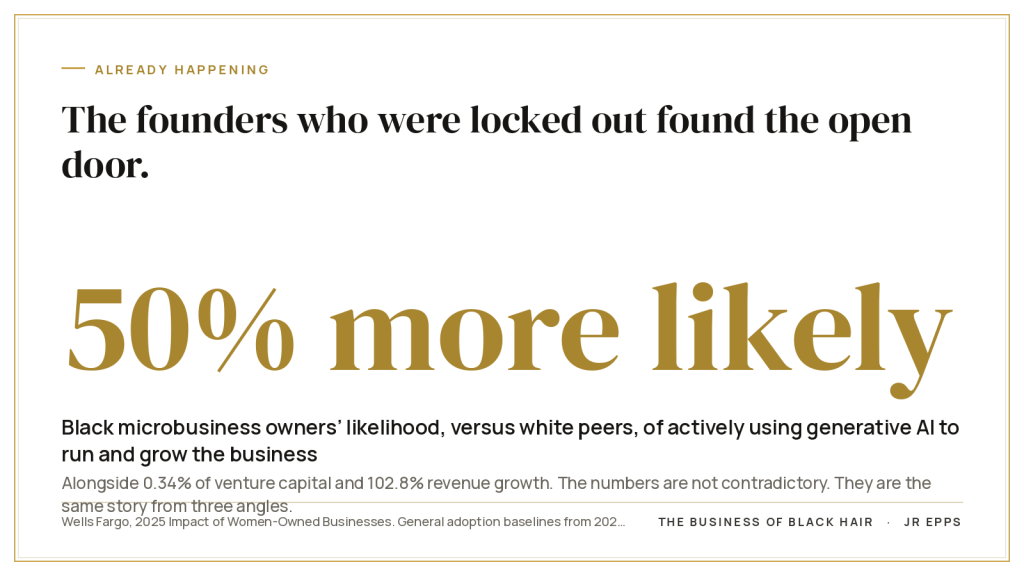
The data says the opposite. According to Wells Fargo’s 2025 report, Black microbusiness owners are 50% more likely than their white counterparts to actively use generative AI to grow and run their businesses. Not 5% more likely. Fifty.
The explanation is not enthusiasm for technology. It is structural necessity. The capital markets described earlier in this series are, functionally, closed: 0.34% of venture capital, a loan rejection rate three times higher, the fund built specifically for women of color dragged into court. When the doors that are supposed to be open are locked, you use the one that is open. Right now that door is a $200-a-month subscription that does the knowledge work a $25,000 consultant used to do.
Put the three numbers together and they stop looking contradictory. Zero capital. Doubled revenue. Fastest AI adoption. It is one story: the founders who were locked out found the tool that makes the locks irrelevant, and they are not waiting for the system to let them in.
Root cause: the Consumer-Owner Inversion survived for a century because expertise was expensive and capital was gated. One of those two conditions just ended. That is the window.
As an engineer I will add the honest caveat: the tools are imperfect, they get things wrong, and they need a human with domain knowledge checking the output. This is the worst these tools will ever be, which is exactly why the person who starts now compounds the advantage. The Business of Black Hair ends with the woman doing her hair on a Sunday and the one thing she has not yet done: capture the equity. The tooling for that just got cheap.